Archives for 2015

Surgery Day (and other tidbits)

hospital sign

By:  Richard M. Kline Jr., M.D

My wife took me to the hospital at 6 a.m., and I sat in the preoperative waiting room with the other surgery patients. Eventually my name was called, and I was taken by a female technician to a room to be weighed. I wanted to say “NOT FAIR!” when she weighed me with clothes, shoes, and cell phone, but I realized it didn’t really matter. Next she took me to a private preoperative room, handed me a gown, and told me to take off “everything”, use the bathroom, and put on the gown. This was definitely unsettling, as I’m not used to taking off my clothes in front of strangers, but I realized I was going to have to comply if I was going to get through this. As I put on the gown, I couldn’t help but think about Jack Nicholson with his butt sticking out of his hospital gown in “Something’s Gotta Give.” After I had changed, the young lady returned, and directed me to lie on the stretcher. She then announced she had to “remove my hair,” and mentioned that others would be coming to check her work. I was a little surprised because plastic surgeons have learned that there is really no need to remove hair before surgery, but the last thing I wanted to do at this point was upset the routine. As I lay there trying to be calm while she trimmed my lower abdomen and groin with clippers, she chatted pleasantly, asking at one point if I wanted the “full Brazilian wax.” After she finished, her female supervisor came in, lifted my gown and inspected the job, then told her to trim another inch of hair off the bottom.  After this was done, I got a short reprieve, after which a third woman came in and “checked my prep” again. At this point, I was starting to get over being inspected, and just wanted to move forward.

Another nurse, the self-proclaimed “i.v. specialist,” entered. She was very bubbly and chatty (perhaps even more so after I told her I was terrified of needles). She complained about me grinding my teeth when the local anesthetic went in my hand, but after that I didn’t even feel the i.v. catheter go in, which was a relief. At that point I thought I was safe, but then she pulled out a syringe, smiled, and said “Lovenox!” That needle went into the left side of my freshly prepped abdomen. I didn’t realize until then that Lovenox burns going in. Ouch.

At last I was prepped, and my wife was allowed in. What a relief to see her again! Soon the anesthesiologist came in to see me. I’d never met him, but I knew my wife worked with him frequently and thought highly of him. He was very calm and matter-of-fact, exactly what I wanted. The surgeon then entered for the final preoperative visit, confirmed the procedure, and marked the surgical site. He was calm and reassuring.

Before they wheeled me from the preoperative room to the operating room, they gave me a dose of i.v. Versed, to “take the edge off.” This was a good thing, as the process of being wheeled down to the O.R. in a stretcher was, for me anyway, surreal. I’m usually the one pushing people down these hallways – this was too weird! As the team wheeled me down the hall I said “this is a very different vantage point from down here,” and they all agreed. Once we got in the OR, they had me move myself from the stretcher onto the table. The oxygen mask went over my mouth and nose, and the last thing I remember was the slight burn of the Propofol anesthetic going into my hand and wrist.  —Lights out—

(Part 3 of this series will post April 23)

7 Ways to Fit into Your Itty-Bitty Bikini

girl in yellow polka dot bikiniOkay, do you hear that ominous music in the background? It sounds a lot like “dun dun dunnn.”

Oh wait, that’s just the sound of bathing suit season rapidly approaching!

Don’t fret—we’ve come up with 7 ways to get you back in that itty-bitty bikini in no time!

These aren’t crash diets either. They are just 7 easy and healthy tips to incorporate into your day to lose those extra winter pounds.

Here’s to being bathing-suit ready this year!

1.    Fill up on vegetables

Waiting to eat until you’re absolutely starving can lead to bad cravings and poor eating choices, so it’s important to eat consistently throughout the day.

Recommendation #1: don’t skip meals.

Sure, you might not be hungry right then, but that hunger will come back with a vengeance later—and it might be in the form of a pizza.

Recommendation #2: fill your plate up with veggies. Vegetables are incredibly filling, and you can pile your plate full of them.

2.    Start the day on a healthy note

Yes, you’ve probably been beaten over the head with this one. Why? Because it is SO important. The National Weight Control Registry, which monitors people who have been successful at weight loss of 30 pounds or more, reports that eating breakfast is one of the weight loss behaviors that most successful participants share (78%).

Starting the day eating something healthy will also help you stay on the right track for the rest of the day. A good rule of thumb is keeping breakfast to 300 calories or less. Try whole grain toast with natural peanut butter. If you’re not usually hungry around breakfast, a fruit smoothie will still stave off snacking later.

3.    Get rid of temptations

Are you serious about cutting the calories? Rid your house of temptations. Trash or donate anything in your cabinets and fridge that call your name in moments of weakness.

Instead, fill up your kitchen with easy go-to healthy foods. Keep ready-to-grab cut-up fruits and veggies always in hand. Using pre determined serving-size tupperware containers are a great way to prevent over-snacking.

4.    Eat less, exercise more

Sure, this one is kind of a no-brainer. But think about it as a math equation. Calories in=calories out.

You can’t lose weight if your calorie intake is substantially more than what you work off. Keep track of how many calories you take in throughout the day and compare to how many you’re burning at the gym.

5.    Stay away from sodium

Foods and beverages with a large concentration of salt make your body retain water. Skip the margarita and salty snacks, and shoot for something with lower amounts of sodium.

Be careful—make sure to check the label; sometimes it’s surprising which foods have a large salt content. In addition, make sure to drink lots of water to flush out impurities in your body.

6.    Hydrate, hydrate, hydrate

Staying hydrated is the golden rule of weight loss. The Mayo Clinic recommends women drink 2.2 liters and men drink about 3 liters. When you drink plenty of water, your body is able to flush out toxins, and you’re able to stay fuller longer.

7.    Burn calories throughout the day

By just making a few changes to your daily routine, you’d be surprised how many calories you can work off! Here are a few recommendations:

  • When you wake up in the morning, do a five-minute exercise routine of jumping jacks, squats, and sit-ups.
  • Park in the back of parking lots so you can walk a little bit farther.
  • Take quick breaks after 45 minutes at work to walk around your building or do some jumping jacks—it’ll help you stay more focused, too!

Join us at the Breast Friends Forever Pink Ribbon Run March 6-7 in Myrtle Beach. Click here for more information…

Ask The Doctor-What can be done about infected implants?

yellow flowerThis week, James E. Craigie, MD, of The Center for Natural Breast Reconstruction answers your question.
Question: I had implants, and they got infected. I had six operations I’m in New York right now, but I’m on my way to South Carolina. I would like to come in so I could see what can be done. Thank you.

Answer: I’m sorry your having problems with your implants. We have helped many women who have lost implants due to infection. Let us know when your in town, and I’ll be glad to see you.

Have a question about breast reconstruction or post-surgical you’d like answered from our surgical team? Just ask!

The Doctor is Out…..

the doctor is outNo worries – he’s back already!  Dr. Kline shares with us his personal experience as a surgical patient and what he has learned from being on the other side of the exam table that will enhance the personal care of his own patients.

“The Doctor is Out” is part 1 of this 4 part series.  Enjoy and have a happy day! – Gail

Three weeks before my surgery, everything was fine. I felt good, a little heavier at 56 than at 26, but still hale and vigorous. Then, while operating late one afternoon, I felt a pain in my groin. “Probably just too much strenuous exercise,” I thought, and dismissed it. It didn’t go away. The next day, it was worse. I felt a bulge. DAMN. I had a hernia.

The whole concept of needing to get treatment, instead of needing to deliver it, was foreign and unsettling. For decades I’d been used to helping other people. Now, whether I liked it or not, I was potentially going to have to sit down and let others help me.

I called the same general surgeon who fixed my 86 year old Dad’s hernia last year (why did mine have to come 30 years sooner?). He told me there was no danger in watching the hernia for a while, and that if I wanted to try and lose some weight it might get better, but it was a long shot.  As it turned out, I didn’t actually have time to try and lose weight, because it started to get worse hurt towards the end of long workdays. I turned over all my long cases to my partner, and I started looking for the soonest, least disruptive time I could find to get it fixed.

I greatly respect the people I work with daily, but I didn’t want to have surgery at the hospital where I usually worked, because I wanted things to be as routine as possible for everyone. I felt that it would be much less stressful on me (and probably everyone else) if I wasn’t in an environment where I was used to giving the orders.

Fortunately for me, my wife is a surgeon, and she regularly works at a hospital I rarely visit. I thought this might be the best place to go – my wife could kind of “watch over” things, but I would not know anyone involved in my care personally.

When I visited the surgeon for my preoperative appointment, he examined me and confirmed that I did in fact have a hernia.  We discussed options, and decided to attempt a laparoscopic repair of the hernia. He advised me that it might turn out that it was too difficult to do the surgery laparoscopically, and that they might have to “open me up.” I assured him that after 20+ years of practicing surgery, I was well aware that things are not strictly predictable, and I asked him to please do whatever he felt he needed to at the time. This was the first time I started to “loosen up” a little bit, and I was actually kind of glad that it would be him, and not me, worrying about the details in surgery that day.

I also found out in his office that I had high blood pressure, for which they put me on medication. I began to limit my salt intake, and cut back on calories. Fortunately, jogging did not aggravate the hernia, so I also increased my aerobic exercise until two days before surgery. Yes, I was “in training” for this.

On the night before surgery, I went to bed early, woke at 2 a.m., and didn’t sleep the rest of the night.

(Part 2 of this series will post April 16)


Upcoming Breast Cancer Events in Charleston

6237594287_de2aef298e_o

The Center for Natural Breast Reconstruction is so proud to be a part of the Charleston, SC, community, which continues to support local women and breast cancer awareness with amazing events and fundraisers.

We encourage you to show your support at these upcoming events in our area for a cause that is dear to our hearts.

April 8—Pink Out Night for The Cure!

Show your support and pink out the stadium at the Family Circle Cup. This fun event raises funds for the Susan G. Komen Lowcountry organization. Wear your best pink attire, and $1 will be donated to help find a cure. Any survivor sporting their 2014 Race for the Cure t-shirt will receive a free general admission!

The gates open at 5 p.m. and play starts at 7 p.m.

For more information, visit the website.

April 11-12—Women living with metastatic breast cancer

Living Beyond Cancer is hosting their annual conference for women living with metastatic breast cancer. This 2-day event provides support, resources, and information to help those with stage IV breast cancer.

The doctors, researchers, nurses, and mental health providers all provide the most cutting-edge information. This is a great opportunity to meet others and be in the company of those who truly understand the struggles of living with metastatic breast cancer.

For more information, visit the website.

May 23—Rock Pink 5k 

This evening race is TONS of fun! From the pink glow necklaces, to the 80s rock band and outfits, to the body paint—this is the place to be! This 5k run/walk embodies the spirit of the cause.  All proceeds go to the Susan G. Komen Lowcountry organization.

For registration information, visit the website. 

Please share this information with your friends on social media!

Ask The Doctor-Does lipomodelling make breasts more natural looking?

purple flowersThis week, James E. Craigie, MD, of The Center for Natural Breast Reconstruction answers your question.

Question: Do doctors do lipomodelling of the affected breast to make it more natural looking? Implant does not help. Thanks.

Answer: Thanks for your question. We perform fat grafting as part of the breast reconstruction process. If you had breast reconstruction with an implant and the results are not natural, fat grafting can help. There are some situations that require removing the implant in order to get a more natural result. Let me know if you need more info.

Have a question about breast reconstruction or post-surgical you’d like answered from our surgical team? Just ask!

6 To-Dos for Your Charleston Staycation

fountain in charleston

Okay, so you’re a little bummed that you’re not jet setting somewhere else for vacation this year.

Not to worry.  People flock to Charleston for their vacations—so why not plan your very own staycation?

The Holy City has so much to offer. From the history and culture of Lowcountry to the beaches and restaurants, there are plenty of activities and fun to experience right here in town!

Here are  6 to-do’s on your Charleston staycation:

Step away from the housework

Drop the broom right this very second! Not leaving for vacation does not mean you should fill it with your to-do list. You’ve earned this time off. It’s time to relax and rejuvenate!

Go back in time

Who says you can’t be a tourist in your own town? Take a historical tour and learn more about the fascinating city we live in! Take a two-hour walking tour of Charleston’s Historic District with experienced guides. Tours depart from The Shops of Historic Charleston Foundation.

Catch up on reading

You know that list of books you’ve been meaning to read? Curl up with a cup of tea and read your heart out! Or stake out a live oak tree covered in Spanish moss to read under. Heck, read from sunup to sundown—it’s vacation after all!

Try a new activity

Experience our beautiful city from a new perspective! Sign up for a Stand Up Paddleboarding or kayak tour and enjoy the outdoors. Trying new activities and exploring new areas is a great way to spend your staycation.

Catch a tour

The Charleston Tea Plantation is one of the few places in America to grow its own tea. Take a tour of the tea factory and learn about the history behind the 127 acres on Wadmalaw Island and taste different teas. The plantation also offers an educational trolley tour so guests can explore the scenic grounds.

Also on site is the Irvin House Vineyards, which produces wine and firefly vodka. Stop in for a tasting!

Beach day

We are lucky enough to have 5 beautiful beaches, aren’t we? Make a day of it with your family or friends! Get out early before the crowds, pack a cooler, set up the umbrella, and make sure to drop by Poe’s on Sullivan’s Island to take a break from the sun!

Are you a local? Share how you’d like to spend your Charleston staycation on our Facebook page!

Ask The Doctor-Will my pectoral muscles will return to normal after I have my implants removed?

purple flowerThis week, James E. Craigie, MD, of The Center for Natural Breast Reconstruction answers your question.

Question: I had a mastectomy with reconstruction using saline implants. I am considering having the implants removed, and am wondering if my pectoral muscles will return to normal.

Answer: Thank you for your question. If you are planning to have your implants removed, then are you planning to have any further reconstruction? Frequently, tissue expanders and breast implants used for breast reconstruction are placed under the chest muscle. If you are having problems with your chest muscles because of the breast implants, it is likely that some of the  problems would improve or possibly go away completely if you have the implants removed. On the other hand, it is very unlikely that your muscles will ever go completely back to normal after they have been lifted up and or divided to cover an implant. In my practice we keep the implants above the muscle. When this is possible the muscle is not disrupted at all. When we have a patient who has had problems with their implants, we can usually help them by removing the implant and capsule and reattaching the muscle. We then perform the breast reconstruction with the new breast on top of the muscle. If you  choose to have breast reconstruction after problems with implants, then replacing them with your own fatty tissue can be a great option. Let me know if you need more information. Thanks again for your question!

Have a question about breast reconstruction or post-surgical you’d like answered from our surgical team? Just ask!

5 Reasons Cleaning Is Good for You

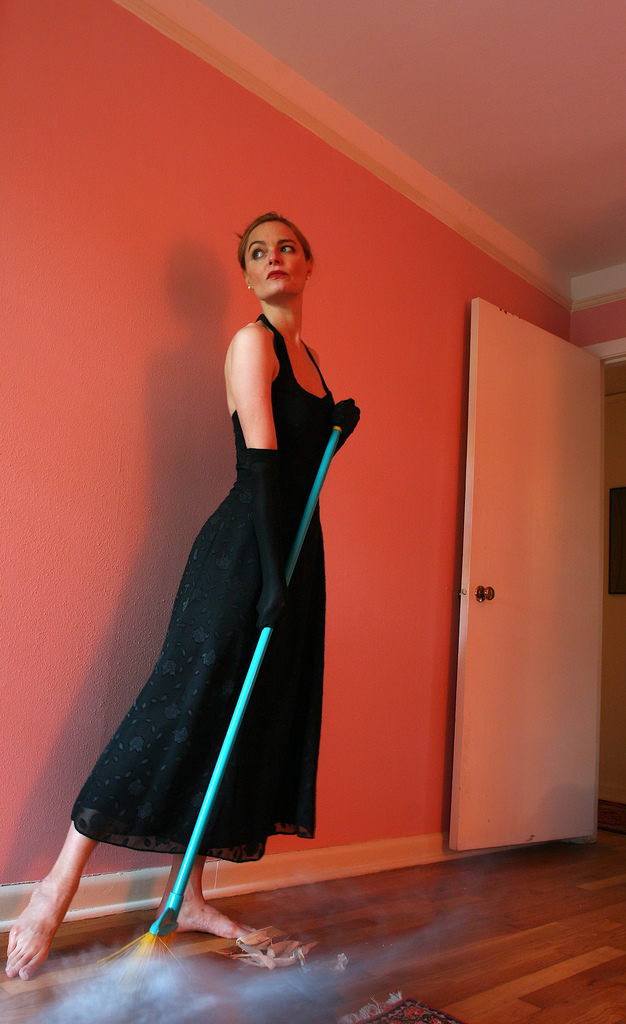
lady cleaning in evening gownSpring has officially arrived, and along with the warmer weather comes, well, spring-cleaning.

It may be a sign of getting older, but somewhere along the way cleaning has somehow become…relaxing?

Sure, we put it off now and again (*cough *all the time), but when you truly get into the cleaning mode, there is something truthfully therapeutic about decluttering your home.

For those who are a little more skeptical of the benefits of spring-cleaning, we have listed the 5 ways cleaning de-clutters not only your house, but also your mind.

1. Clutter is stressful

This is just a plain and simple fact. When our house is a mess, we always have that in the back of our minds. We may even avoid coming home, because the mess is so overwhelming.

Spring-cleaning tip: tackle the clutter and disorganization first—that way everything is out of the way to finish the cleaning process.

2. Swiffer those calories off

Cleaning can be a real workout. You’re vacuuming and climbing all around dusting, and the next thing you know you’ve broken a sweat! When you workout, endorphins are released. And we all learned from Legally Blonde: “Exercise gives you endorphins. Endorphins make you happy. Happy people just don’t shoot their husbands.” The takeaway: cleaning makes you feel good, because you are up and moving about.

Spring-cleaning tip: to stay moving and motivated, put on some energetic music!

3. Sense of control

With life being so unpredictable and problems always arising, there is something comforting about cleaning. You know that if the fridge is dirty, you can fix that problem. Having the ability to tangibly make order out of chaos is a reassuring feeling.

Spring-cleaning tip: Pinpoint what is overwhelming you the most about cleaning your home, and tackle that first. This will help ease your mind.

4. Peace of mind

There are very few things as frustrating as when you’re trying to get out the door and you can’t find something, because the house is a disaster. Part of the reason cleaning is so relaxing is that it’s so nice simply knowing where everything is. When everything has its own place, your day-to-day routine becomes a lot less hectic.

Spring-cleaning tip: When you’re cleaning, don’t just throw everything into drawers and to the top of your closet. Take the time to thoroughly organize each area. By doing so, your house will stay orderly for a longer period of time.

5. Feeling of accomplishment

Doesn’t it always seem like your best cleaning comes when you have other things you need to be doing? That’s because you get a true sense of accomplishment from getting your home into good shape. The next time you have a hard time getting motivated to do something, try cleaning a small area of your home—it’s gets you moving and in the spirit to accomplish other things.

Spring-cleaning tip: If you’re feeling overwhelmed about where to begin, make a checklist in the order of items you want to accomplish.

What do you love about cleaning? Comment below!

Ask The Doctor-Is it possible to do a flap reconstruction after first surgeon tried expander on radiated breast on a smoker?

flowerThis week, Richard M. Kline, Jr., MD, of The Center for Natural Breast Reconstruction answers your question.

Question: Is it possible to do a flap reconstruction after first surgeon tried expander on radiated breast on a smoker who had quit 7 weeks before surgery? 4 weeks later I still have open wounds almost the size of a quarter.

Answer: Thanks for your excellent question.

Fortunately, previous breast surgery, no matter how extensive, rarely impacts our ability to do a flap reconstruction using your own tissue. In fact,  a healthy, non-radiated flap is often beneficial in improving the quality of the radiated tissue around it.

As you seem to already be aware, nicotine is an absolute “no-no” when having surgery, and also when trying to heal a chronic wound. Nicotine causes the microscopic blood vessels in your tissue to clamp down, just like shutting off a valve, which deprives the healing tissues of oxygen. Usually, however, nicotine levels are unmeasurable after a full month of exposure cessation.

We have treated several chronic wounds in patients with failed implant reconstructions, and we have always felt that it was best to get the wound healed before proceeding with flap reconstruction. Achieving healing in these situations is often not straightforward,  but we have thus far eventually been successful. Sometimes retained foreign material (such as Alloderm) can play a role in keeping the wound open, and sometimes there is just not enough skin left in the radiated area. Rarely, deep infection of the bone or cartilage can be an issue, although this is unusual.

If you wish, we can set up a phone consultation to discuss your specific circumstances in more detail.

Best of luck, and thanks again for your question.

Have a question about breast reconstruction or post-surgical you’d like answered from our surgical team? Just ask!