Search Results for: implant

Ask the Doctor-What are Your Suggestions For Muscle Spasms After Breast Reconstruction?

This week, Richard M. Kline, Jr., MD, of The Center for Natural Breast Reconstruction answers your question about breast reconstruction.

Question: I had breast reconstruction on my left breast in 2006. I have had muscle spasms in it ever since. Recently they have gotten bad again. Any suggestions?

Answer: I’m sorry you are having problems with your reconstruction.
You didn’t mention if you were reconstructed with an implant or with your own tissue, so I will answer as if you are reconstructed with an implant. Please let me know if I have assumed wrongly.

There are several potential reasons why you could have spasms. If the implant was placed under the pectoralis chest muscle, it can lead to pains in the pectoralis muscle or other muscles, as the muscle is no longer functioning in precisely the way it was designed to. Most people tolerate the implants well, but there is no question some have more problems than others. The muscle can also sometimes separate from attachments to the chest wall over time, which could cause changes in symptoms. Additionally, If you are radiated, this could potentially cause additional problems, as the muscle may be less flexible.

If you can, I would contact your original plastic surgeon, as he or she is probably in the best position to evaluate your symptoms. I would also be happy to discuss your situation with you further by phone, if you wish.

Thanks for your question.

Have a question about breast reconstruction or post-surgical you’d like answered from our surgical team? Just ask!

Ask the Doctor- I’m Unhappy With My Reconstructive Result from Another Surgeon – Are You Able to Make It Look More Natural?

This week, James E. Craigie MD, of The Center for Natural Breast Reconstruction answers your question about breast reconstruction.

Question: Three years ago, I had a double mastectomy and am now cancer free. My plastic surgeon did a terrible job with the reconstruction. The left side implant is way off to the outer side and looks larger than the right side. The right side is way too far to the outside. There is zero cleavage. Is there any way to re position the implants more to the natural position of the breast ? I do not expect perfect but don’t like looking like a botched job. Thank you.

Answer:  I’m glad to hear you have been cancer free and have your treatment for breast cancer behind you. At the Center for Natural Breast Reconstruction it is part of our mission to help women move on with their lives after breast cancer. We focus our efforts on helping women get their bodies back together with permanent ”natural results”.

I’m sorry you are disappointed with your reconstruction. If you have had radiation then it may be very hard to have your breasts match with implant reconstruction. If you have not had radiation then perhaps your implants could be revised or adjusted for an improvement. Unfortunately these corrections are all too often temporary. It is possible that using your own fatty tissue would be a more permanent option without implants.

Sometimes it is hard to start over with another approach but it may be necessary if you desire a more natural and permanent result. If you would like more information about natural breast reconstruction with your own tissue let me know.

Have a question about breast reconstruction or post-surgical you’d like answered from our surgical team? Just ask!

Breast Reconstruction Surgery: 16 Pre-Op Q&As from Our Physician Assistant

Breast reconstruction surgery can be scary. And we know that you’re bound to have questions about what to expect when it comes to the surgery itself and the healing process afterwards.

Thankfully, we have a handful of reconstruction surgery experts at The Center for Natural Breast Reconstruction. We’re thrilled that one of our very own Physician Assistant, Audrey Rowen, PA-C, takes special care to personally answer reconstruction surgery questions asked by our patients. We were particularly impressed by this group of them and wanted to share with you!

If you’re about to have breast reconstruction surgery, or are considering the option, please keep reading! We think you’ll find comfort in the answers below.

1. Where will the scars on my breasts be and will I be able to wear low-cut tops like I did before?

We try to use previous implant scars if we can, but sometimes we need to do things a little differently in order to access the blood vessels behind your breasts.

The incisions we make are generally below the nipple line and should be covered by most clothing. The shape and overall appearance of the breasts after stage 1 is not the final result so things won’t look as you are hoping until after the second stage. But, every person is different, and we will be better able to answer this question at your pre-op marking appointment and after your first surgery has been completed.

2. How long will I be in the surgical bra?

We typically keep our patients in the surgical bra for a minimum of 6-8 weeks and during any strenuous activity after that. After most healing is complete, we can switch you to a front-closing sports bra or other similar bra that provides support without being too tight. Most women wind up wearing a surgical bra through the first 2 stages and may be able to go without a surgical bra after that.

3. I think you said you could make me a C cup. I’d like you to make me as big as you can with what I have to work with.

We will do our best to give you the biggest flaps we can at the first stage. After that we can do fat grafting to increase the size of your breast. 

4. Does more fat in my tummy area make bigger, better breasts?

It can. This doesn’t mean we want you to go out and try to gain a bunch of weight before surgery because you can’t target where you want to store fat. In fact, sometimes the fat goes around your intestines or below your abdominal muscles, and we can’t get to that fat. Women who have larger tummies often have larger flaps, but we can always use liposuction to gather fat from other areas (buttocks, thighs, inner knees, waist area) at subsequent stages to add volume to the breast mounds later.

5. I understand they will not be pretty at first, but will they be lumpy or smooth, or what should I expect about how they are going to look in the beginning?

Every patient is different so the outcomes are not always standard. At the first stage, you will have what we call a “window” where the donor site flap skin is visible on your new breast. This does not mean it is an opening, but rather imagine that a piece of your skin is donor skin while the rest of your breast has your original breast skin.

This is not always permanent as we can sometimes completely close the breast skin on top of the flap, but in some patients who could not have skin-sparing mastectomies, they may always have that section of tummy skin showing.

Things stay pretty swollen for up to 2-3 months so there may be hard or squishy areas that may change throughout your recovery. We try to create a semi-smooth transition from your breast/chest skin to your donor site flap, but our main priority at stage one is to get the blood vessels attached and keep them working.

Things may look a little deformed, asymmetrical, or strange after the first stage, but we fix these issues at stage 2. You are also likely going to have what we call “dog ears” on either side of your abdominal incision from pulling the skin together. This will also be fixed at stage 2.

6. I think you said I wouldn’t need to have mammograms anymore. Is that correct?

Usually, you will not need any mammograms after having a mastectomy with reconstruction. Your oncologist often makes the definitive decision if you are at any increased risk of recurrence or need any routine monitoring. We still highly recommend doing monthly self-breast exams to monitor for any changes. If it does, please notify us or your oncologist/breast surgeon if you find anything of concern.

7. I would like to see some before and after pictures of the different stages and final result. How can I accomplish this? Can you send some to me?

We have some pictures on our website that show you the before and after photos. We do not have any designated photos of the in-between stages to show you, unfortunately. Dr. Kline may have a few extra pictures to show you at your pre-op marking appointment if you wish.

Click here to view our image gallery. 

8. Will you be lifting my left breast to make it match the right one that doesn’t sag because of the radiation?

We always take radiated breasts into consideration when making the flaps. We sometimes make a radiated breast flap a little larger to account for this, or we lift the non-radiated breast more. Most of this tweaking is done at stage 2 or 3, and there is no hard-and-fast guarantee of how the radiated tissue will do. But, we try our best to give you a symmetrical result.

9. How is the fat grafting accomplished? With needles or what?

Fat grafting is done just like traditional liposuction, but instead of throwing away the fat, it gets strained of any debris, blood vessels, etc., and gets injected back into your body, just below the skin, wherever it is needed.

We only make a small incision through which we insert a cannula that gets shifted around under your skin to collect the fat cells. We make a few incisions in the donor sites that are discussed with you before your surgery and those incisions are closed with a few stitches and a little Dermabond glue on top. The strained fat is then inserted with a special bendable needle that can be shaped to follow around a breast mound or however we need it to go to inject the fat.

10. After the fat grafting, will that fat continue to replenish itself? Like if I gain weight, will my breasts get bigger?

After liposuction, fat accumulation tends to appear in areas other than sites that you have had the fat grafting from. This doesn’t mean you will never get fat in those areas again, but it often finds its way to a few different places. Your breasts will be your own tissue and fat, so if you did gain weight, you could possibly gain weight in your breasts and the same goes for losing weight. 

11. Will my C-section ledge be gone?

We try to take other abdominal scars into consideration when finding the best placement of your new “abdominoplasty” scar. By removing the tissue located on your abdomen, there is a good chance your C-section ledge will resolve, but we cannot guarantee this. It’s another one of those things that depends on the patient, and we will have a better answer for you when we do your pre-op marking.

12. When can I drive?

We don’t want you driving as long as you have drains in (breast or abdominal), which is typically 2-3 weeks. Also, if you are taking any prescription pain medication (Percocet, Dilaudid, Valium), we don’t want you driving until you have switched to taking over-the-counter medications.

We also want to ensure that you feel you can be a defensive driver and not worry that if you had to swerve out of the way, you’d hurt something. Most women sit in the back seat away from the airbag for about 2 weeks and often place a pillow between their chest and the seatbelt to help cushion the pressure from the belt itself.

13. When can I have sex?

We don’t recommend any strenuous activity for several weeks following surgery. I would plan to wait at least 2 weeks and then see what may be tolerated. You don’t want to be using your abdominal muscles for up to 6-8 weeks so you have to be mindful of your limitations. As things heal and you progress in your recovery, you may increase activity as tolerated.

14. Can you also remove the lump of scar tissue from the four drains that were put in my rib area by the other doctors? It makes my bra roll up, and it’s uncomfortable.

Depending on the exact location, we may be able to remove it at the first stage, but it is more likely that we will look into that at second stage as the process of harvesting and grafting the blood vessels is very time-consuming and is the main priority at that time.

15. When will I know if my nipples have to be removed?

This is really a question for your breast surgeon. If you are able to have a nipple sparing mastectomy, we cannot guarantee that your nipples will live as they can sometimes scab over and become necrotic. But, there is also a good chance they will survive. In the event that one or both of your nipples needed to be removed or did not survive, we have multiple options for nipple reconstruction.

16. Can I go ahead and get my flu shot before I have my surgery?

As I am answering this, I don’t believe it is currently flu season, and we would rather not introduce anything into your body this close to surgery. I would wait until 1-2 months after surgery.

Do you have a question about breast reconstruction or post-surgery that you’d like answered from our surgical team? Ask the doctor now 

Ask the Doctor – How Many Trips are Required to Have Reconstruction with Your Doctors

This week, Richard M. Kline, Jr., MD  of The Center for Natural Breast Reconstruction answers your question.

Question: I’ve had implants since a 2004 mastectomy following breast cancer diagnosis. I’m healthy, but feel that my implants have shifted and I’m considering a redo. I live in Colorado, and wonder how the system works for out of town patients. How many trips are required to have reconstruction with your docs?

Answer: By “considering a redo,” I’m assuming you mean replacing your implants with your own natural tissue.

Our P.A. Audrey and N.P. Lindsey spend a lot of time on the phone with out-of-town patients (and their local health care providers) before we ever see them, making sure that nothing important is overlooked before you make the trip. I recommend that at some point you and I also have a phone consultation, so that you will have an opportunity to directly ask me any questions you wish. We usually see you for the first time the day before surgery. On that morning, you get an MRI angiogram at Imaging Specialists of Charleston, then bring the disc to our office to help us plan your flap. We operate the next morning, and you usually spend 4 nights in the hospital. We recommend that you stay in town another 5 nights, if possible, although this is not absolutely required.

We actually discourage you coming back for follow-up visits, as travel is a significant risk factor for blood clots, which is a risk of the surgery (as it is for many other surgeries). If you have a local health care provider who can help with drain management (plastic surgeon, breast surgeon, primary care, etc.) that is helpful, but certainly not essential.  We stay in close contact with you via telephone and secure messaging to manage your post operative period.  You’ll send updates and photos on a routine basis and discuss your progress with our clinical staff.

Most of the time it will take at least 2-3 surgeries to complete the reconstructive process. If you are not radiated, these can be done as closely as 3 months apart (although they can be delayed as long as you wish). None of the subsequent surgeries are anywhere near as big as the initial surgery, and usually you can get by with just two nights in Charleston.

Hope this is helpful, and I hope I get the opportunity to meet you.

Have a question about breast reconstruction or post-surgical you’d like answered from our surgical team? Just ask!

Ask the Doctor- I’m Looking For a Plastic Surgeon that Specializes in Microvascular Breast Reconstruction. Are You in my Insurance Network and Do I Have to Make a Huge Down Payment Before Surgery?

This week, Gail Lanter, CPC of The Center for Natural Breast Reconstruction answers your question.

Question: I am looking for a p.s. who specializes in microvas. breast recon. I had dcis in 2014 lumpectomy with 6 weeks rads followed by bilat mast. 2016 with immed. recon with expanders then implants in March. Then I got a serious infection in the left (rad) breast, had implant removed and refused to do have lat flap done.

I am thin and one ps said I might be able to do a bodylift type or one where they take from my backside and use an implant on both sides. I do not want the implant I have now. It is subpec and is painful. Can someone help? I have anthem bc/bs and you are out of network.

I do not have 8500 to have this done at another location. My insurance is agreeable to a pay if the it is in network. I can’t afford much out of pocket. We are low middle class, but don’t qualify for help.

Answer:  Hi and thanks for your inquiry. Glad you found us – you’ve definitely found a team that specializes in microvascular breast reconstruction. Regarding your insurance, does your card have a little suitcase on the lower corner of your card? If so, we’re actually in network for you utilizing the Blue Card program through our contract with BCBS of S.C.

I’m happy to check into that and assure that is the case if you would like. I’d only need a copy of the front and back of your card and some basic demographic information like – Name of insured on card and birthday if different from yours, your birthday, and address. I can run eligibility in a matter of minutes once I’ve received the information.

Also, I am sure that one of our physicians will be sending an answer to the remainder of your question very soon.

I look forward to your reply, we’d love to help you!

Have a question about breast reconstruction or post-surgical you’d like answered from our surgical team? Just ask!

Flap Reconstruction Surgery: Important Stats and Abstract Information

If you’ve had breast cancer and are considering reconstruction surgery, it’s possible that one of the options you may be looking into is flap reconstruction surgery.

Breast reconstruction utilizing “flap” techniques are procedures where body tissue is used to reconstruct the shape of your breast after surgery. While it’s a relatively common type of reconstructive surgery these days, we feel it’s important that you should learn as much as possible about the benefits and risks, and discuss them with your doctor before you have the procedure.

That’s why we at The Center for Natural Breast Reconstruction are always looking for better ways to educate and inform our patients before a decision.

One way we ensure our patients have access to the latest in medicine and medical technology is to have our surgeons and staff constantly learning, researching, and writing about their findings.

In fact, some of our latest research on reconstructive flap surgery was recently submitted to the American Association of Plastic Surgeons by our Dr. Kline. This specific abstract documented the success rate of our reconstructive flap surgeries with regard to the role of autogenous microvascular breast reconstruction in the community.

Check it out…

Abstract

PURPOSE: To present the continuing role of autogenous microvascular breast reconstruction in the community

METHODS: 1393 free perforator flaps for breast reconstruction were performed by two surgeons from October, 2003 to October, 2016. All flaps were performed in two community hospitals. Types of flaps included DIEP unilateral (122 flaps), DIEP simultaneous bilateral (866 flaps), DIEP bipedicle (106 flaps), sGAP unilateral (55 flaps), sGAP simultaneous bilateral (202 flaps), iGAP unilateral (2 flaps), iGAP simultaneous bilateral (18 flaps), PAP unilateral (5 flaps), PAP bilateral (10 flaps), SIEA unilateral (3 flaps), SIEA simultaneous bilateral (2 flaps), and TFL perforator (1 flap). The series includes a large number of both immediate and delayed reconstructions, prior failed reconstructions, and patients with a history of radiation.

RESULTS: Overall flap survival rate was 98.2%. DIEP survival rate was 99.1%. sGAP survival rate was 95.7%. No primary unilateral flaps were lost, and no bilateral losses occurred. Including those patients whose initial flaps failed, 99% of patients were ultimately successfully reconstructed with autogenous tissue.

CONCLUSION: Implant-based reconstruction is an appropriate initial choice for many patients, but autogenous microsurgical reconstruction still remains an excellent option, whether as an initial choice, or for patients with a prior history of failed reconstruction. With proper preparation and institutional support, perforator flap breast reconstruction can be performed with a high degree of success in a community hospital setting.

On top of the abstract, our physicians—Richard M. Kline Jr., M.D. and James E. Craigie MD—also wrote the chapter on GAP (buttock) flaps for the book Perforator Flaps for Breast Reconstruction.

Check out the book chapter here.

As we mentioned earlier, we are passionate about continuing to learn, receive training, and interact with the scientific community to ensure we provide our patients with the safest, most advanced care.

And, while we’re doing our job to make sure we’re properly training our staff and staying up-to-date with the latest in medical technology, there’s one thing we encourage you to do as well—always ask for medical procedure stats.

Much like the abstract we provided above, your doctor should be able to provide you with stats on the procedures he or she conducts.

When patients come to us and ask questions on success rates, we can happily tell them the different percentage rates of success for the various procedures we provide. Equipping our patients with this information empowers them to make wise, educated decisions about their own health.

So, please, before you move ahead with a specific procedure, ask your doctor for the stats. If they have a high success rate with their surgeries, then you’re in the right place. If they don’t, it’s time for you to find another doctor.

We wish you the best as you move forward with any new procedure you may need!

Did you find the book chapter insightful? Let us know what you learned and what you thought was helpful to know in the comments below!

Ask the Doctor-I Had DIEP Surgery that Failed and Have No Left Breast. What are my Options Now for Reconstruction?

This week, Richard M. Kline, Jr., MD and James Craigie, MD of The Center for Natural Breast Reconstruction answers your question.

Question: I had left implant removed due to contracture. ( double mastectomy and left radiation) Just had DIEP surgery that failed so now have no left breast. I am thin , especially now with little belly removed. What are my options for reconstruction now?

Answer:  I’m sorry you are having such difficulty getting a satisfactory reconstruction. As you know, given your history of radiation and prior problems, you are unlikely to ever get a successful reconstruction of the left breast with an implant.

When the DIEP is not available, the next option is often the sGAP flap (from the buttocks). This is far less widely available than the DIEP flap, but we have performed about 300, with a 95.7% success rate (our DIEP success rate is a little higher, at 99.08%). Other options include the PAP flap, from the posterior upper thigh, the anterolateral thigh flap, and the latissimus flap. The latissimus is rarely large enough to use by itself, and is usually combined with an implant; unfortunately, in a radiated tissue bed, the implant still often does not work well, even with a latissimus covering it.

Sometimes we can do two smaller flaps at the same time to reconstruct one breast. This is more difficult with a previous flap failure, as the recipient vessels are a little harder to reach, but we have done it successfully in some cases.

Over the last few years we have gained extensive experience augmenting the size of natural tissue flaps with fat grafting. This basically means we first do a natural tissue flap, then come back a few months later and do liposuction (yes, it can be a problem getting fat in some people), then inject the fat with specially designed needles into the flap. On some occasions, we have essentially doubled the size of flaps, although our ability to do this obviously varies with different patients’ body types. We have successfully made small “C” breast mounds even with latissimus alone + fat grafting, however.

I would be happy to chat with you by phone, or see you in person and discuss your options further, if you wish.

Thanks for your question!

Answer #2:  I’m sorry to hear you have had a difficult time. I’m sure you still have options. If I had additional information about the size of your natural breast and your body weight I could perhaps be more specific. In our practice we use your own fatty tissue without muscle sacrifice. If the DIEP did not work out then possibly thigh, or buttock fat or a combination of the two would be an option.


Have a question about breast reconstruction or post-surgical you’d like answered from our surgical team? Just ask!

Ask the Doctor- Can I See an Image of An Expander Before Surgery? Is There a Metal in the Frame to Maintain the Shape”?

This week, Gail Lanter, CPC of The Center for Natural Breast Reconstruction answers your question.

Question: Can I see a picture of the expander before it goes into the body?

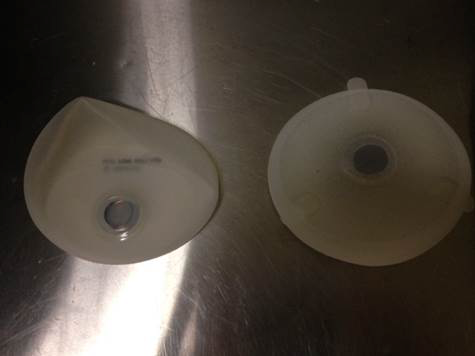
Answer:  Absolutely! Thanks for your question Mary Lou. Tissue expanders come from a myriad of manufacturers in a wide variety of sizes; each with different shell styles and features. This photo shows two that we have on hand now as samples.

The one on the right with the tabs is by Natrelle and the smaller on the left with no tabs is from Mentor.   The magnetic disc in the middle of each is the fill area.   Are there specific questions you would like answered about breast reconstruction with tissue expanders.  We’re happy to help!

Question: Thank you for the picture of the two different tissue expanders. The expander that is on the left, that comes to a point- is there metal in the frame of it to keep it’s shape? Thank you again for the information.

Answer: No ma’am, there is no support system. Just a shell. Expanders like these start empty and are made to be replaced with permanent implants. The expansion process and saline within is what gives the shape. The only metal is in the magnetic disc used to locate the port during that process.
Hope that helps!

Have a question about breast reconstruction or post-surgical you’d like answered from our surgical team? Just ask!

Ask the Doctor- Why Do Expanders Have To Be Used When a Breast is Removed?

This week, Richard M. Kline Jr. M.D., of The Center for Natural Breast Reconstruction answers your question.

Question: Why do expanders have to be used when breast are removed and the pocket is empty and ready to be filled with an implant?

Answer:  It is not always necessarily to place expanders at the time of mastectomies, but in many situations it is a safer choice than immediately putting in an implant. Even if the breast surgeon leaves the nipples and removes no skin at all, the skin is not always healthy, as the blood flow is invariably at least somewhat compromised after mastectomy. Placing an implant very poorly perfused skin would put additional pressure on the skin from within, and quite possibly cause skin to die that otherwise would have lived. With an expander, we have the option of placing no fill at all at the initial surgery, thus minimizing additional pressure on the skin. In actual practice, sometimes the skin’s blood supply is so poor we don’t even put in an expander right away, but rather return to the operating room several weeks or months later to begin reconstruction.

Having said the above, I do agree it is nice if the final implant can be placed under healthy skin flaps immediately. However, it should only be done under ideal circumstances.

Have a question about breast reconstruction or post-surgical you’d like answered from our surgical team? Just ask!

 

Ask the Doctor – What Would Deem Breast Reconstruction Medically Necessary and How Much Does It Cost?

This week, James E. Craigie, MD, of The Center for Natural Breast Reconstruction answers your question.

Question: Hi. I was wondering if you could answer a couple of questions. My first question is what would deem breast reconstruction medically necessary? My second question is how much would breast reconstruction and nipple reconstruction cost? I am a size B and have collapsed breasts. I used to be a double D. My nipples are also partially inverted.

Answer:  Breast reconstruction is generally regarded as being medically necessary if the breast is removed for cancer, or to prevent cancer in certain high-risk individuals. It sounds like what you are asking about would be considered cosmetic breast surgery. The most common cosmetic breast surgeries are breast augmentation (with saline or silicone filled implants), breast reduction, or breast lifting. What you describe as “collapsed breasts” could potentially be improved with a breast lift, breast augmentation, or a combination of the two.

Inverted nipples are caused by shortened ducts leading to the nipples. They are fixed by making a small incision adjacent to the nipple and dividing the ducts.

Gail in our office can give you prices for these procedures.

Thanks for your question.

Have a question about breast reconstruction or post-surgical you’d like answered from our surgical team? Just ask!