10 Questions to Ask Your Breast Surgeon

breast surgeryUndergoing any type of surgery is stressful. But the best way to reduce your fears, stresses, and concerns is to do your research and be prepared both before and after surgery. It’s important to understand possible complications during and after surgery, as well as details on the actual procedure.

For patients who are considering breast reconstruction surgery, it’s important to talk with your doctor about your concerns. Some of the most important questions to ask include . . .

1.     Why are you recommending this procedure?

2.     What are the risks? How do they compare with the benefits?

3.     How do I prepare for surgery?

4.     What type of anesthesia will I have?

5.     What happens during and right after surgery?

6.     Who do I talk to about breast reconstruction?

7.     How long will I be in the hospital?

8.     Are there possible complications?

9.     When can I go back to work and resume normal activities?

10.  What are the risks of lymphedema?

Did you find this post helpful? We’d love to hear from you in our comments section.

Breast Cancer Survivor Shares Reconstruction Success Story

according to shirleyWe are so happy to share with you another In Her Words post, this time with Shirley Trainor-Thomas, a breast cancer survivor, Hodgkin’s lymphoma survivor, and reconstruction success story!

Shirley was a patient of ours at The Center for Natural Breast Reconstruction and we are delighted to share her story with you.

See below for the interview (*Don’t forget to download a copy of According to Shirley, a short story / information booklet written by Shirley about her breast reconstruction experience):

When you were diagnosed with breast cancer in your left breast, you chose to have a double mastectomy. What influenced this decision? In other words, what factors did you consider when deciding whether or not to have a double mastectomy?

“It’s not good, princess.” Those were the exact words Dr. Bob Flowers used when he called to tell me the results of my biopsy. I promptly informed him that it was not the right answer! And after I caught my breath, I asked what we were going to do about it. He said he would get me to a surgeon that very day. True to his word, my husband and I were in Dr. Stan Wilson’s office that afternoon and we started discussing options. I was a bit of a difficult case because many years ago I had Hodgkin’s lymphoma and radiation to my entire torso—which is what likely caused my breast cancer. There was a lot of discussion among physicians and tests that were taken to make sure we had all of the information we needed to make the best decision.

The waiting to get answers and opinions that would lead to a plan was excruciating. All I could think about was breast cancer and I spent endless hours on the Internet trying to learn everything I could about my diagnosis and choices. My husband and I were in a fog.

Long story short, it appeared that chemo and mastectomy was my option. But, Dr. Wilson wasn’t totally convinced chemo was the really indicated and sent my tissue to have the Oncotype test.   As we waited on those results, we were moving forward with the chemo option. On a Thursday evening, I was preparing for surgery to take place the next morning to have a port put in—and at 8:00 pm, Dr. Wilson called with the Oncotype results—they were great. We opted to not have chemo.

Because other cells in my breasts were described as “busy” by the pathologist, I knew there was a chance of cancer striking my other breast. Given the painful waiting and emotional impact we went through, my husband and I said that we need to eliminate the chance of having to go through this again. Playing into that decision was that I was aware of the DIEP reconstruction option. I’m lucky, not everyone knows about that option and most people have to do a lot of research to find it or the right surgeon. I knew right out of the gate that the only person I would allow to do this procedure was Dr. Richard M. Kline, Jr. of The Center for Natural Breast Reconstruction.

2. What type of reconstruction surgery did you have and how do you feel about the results? Would you make the same decision again if you could go back?

I had DIEP. The great thing for me is that I went into surgery with bosoms and came out with bosoms—and a flat tummy. Bi-lateral mastectomy and reconstruction were done in one surgery.

Recovery was frustrating. As Dr. Kline kept telling me, “It’s a process.” No matter what he told me, I was convinced I would be back to normal in just a few weeks. Okay, so it took longer.  I got tired easily and couldn’t stand up straight for a while because of the stomach incision. But, my job requires travel and I was able to get on an airplane six weeks after surgery and get back to work.

My energy level took some time to return—it’s a big surgery. But, if faced with the same decision today, knowing what I know, I absolutely would do it again.

My bosoms are perfect.

Unfortunately, I didn’t have enough tummy fat to make them bigger than they were (my one chance—had I known, I would have eaten a lot more over the years!). Even my oncologist has marveled at how real they look and feel. But I would only allow Dr. Kline and Dr. Craigie to do it. I’ve read some horror stories online about women who went to surgeons who either weren’t trained properly or didn’t have the skill level needed for microsurgery. I actually communicate with women around the country to share my experience and to alert them that they really need to investigate their surgeon’s success record.

3. You decided to write a short story / information booklet about your breast reconstruction experience titled According to Shirley. Why did you choose to write this book and what do you hope readers will get from reading it?

I love Dr. Kline and his entire staff. But, when planning for surgery they gave me a booklet of what to do and expect. After going through the experience, I let them know they left A LOT of information out! It was written by medical professionals who never actually experienced the procedure. When I told them that the information was technically good, but needed to include more practical information, they said fine—write one. So I did. It’s really meant to give women a better idea of what to expect throughout the process and to keep positive about the experience.

4. What advice would you give to women who have undergone a mastectomy or double mastectomy and are unsure about natural breast reconstruction?

Research, research , research. Unfortunately, not all plastic surgeons will present options that they are not capable of providing, such as DIEP. Talk to several surgeons and get a feel for the success rate of the surgeon. Talk to their patients. It’s a major procedure. Women need to know how many procedures the surgeon has done and what his or her success rates are.

Have you downloaded your copy of According to Shirley? If not, click here.

How to Address Stubborn and Chronic Back Pain

back painBack pain is not merely inconvenient; it can incapacitate you and make everyday living painful and difficult. Statistics show that 70–80% of us experience severe or prolonged back pain at some point in our lives.

In addition to pain relief creams and stretching exercises to do at home, your doctor can prescribe heat treatments, braces, and medications. If you have stubborn or chronic pain and are open to complementary or alternative therapy, you can manage back issues whether your pain is in the neck or upper, middle, or lower back.

Always keep your doctor informed about any complementary therapies you decide to try, and make sure that any professionals you work with are appropriately licensed in their fields. A simple Google search will tell you all you need to know about certification and licensure.

Yoga and Tai Chi

The slow, gentle movements in yoga and tai chi stretch your back muscles and increase blood flow, helping to reduce pain. No matter which part of your back hurts, your instructor will know at least one pose to alleviate pain—and you’ll feel relief in minutes. Yoga and tai chi require little to no equipment, so you can do them anywhere you have a little room.

Physical Therapy

A physical therapist will not only show you exercises to reduce back pain, but he or she will also show you how to move to keep pain at bay. You’ll discover how to get up from a chair, walk, bend over, and pick up items correctly. He or she will also discuss how good posture will help your back.

When you work with a physical therapist, you’ll have exercises to do at home as well as appointments for therapy in an office or hospital. Physical therapists use a range of equipment and tools, such as stationary bicycles and heated pools.

Massage Therapy

A good massage therapist will soothe your back pain while working on the muscles that are causing you to hurt. When you meet your massage therapist, describe exactly where the pain is and how sharp it is so he or she will know which muscles to massage. Often, therapists work with essential oils and salves to further decrease pain and relax muscles.

Chiropractic

Spinal manipulation is an excellent tool for realigning the body and reducing back pain, whether it is acute or chronic. As with physical therapy, your chiropractor may use a variety of tools to help you in the office and send you home with a list of exercises. Many people use chiropractors on a short-term basis, while others visit regularly even after the pain is gone.

Acupuncture

An ancient Chinese therapy, acupuncture involves very thin needles inserted in specific areas of the body to balance the flow of energy and reduce pain. Back problems, as well as knee and elbow pain, are commonly treated with acupuncture, though not everyone will respond to the therapy.

Loved this post? Visit us on Facebook for more health and wellness tips.

Breast Reconstruction Surgeons Answer Your Questions About Reconstructive Surgery

reconstruction optionsThe question below is answered by Charleston breast surgeons Dr. James Craigie and Dr. Richard M. Kline, Jr., of The Center for Natural Breast Reconstruction.

What is the difference between breast reconstruction and augmentation?

Breast augmentation is when you increase the size of a normal healthy breast, almost always with saline or silicone gel implants.

Breast reconstruction is restoring the form of a breast that has been damaged, partially removed, or completely removed. Breast reconstruction is almost always done after treatment for breast cancer, although there are some birth defects that can result in the need for breast reconstruction. Breast reconstruction can be performed with implants (the same ones used for breast augmentation), or with the body’s own excess tissue (usually from the abdomen or buttocks), thus avoiding the need to place foreign objects in the body.

What are the pros and cons of a DIEP versus a TRAM flap reconstruction?

The primary advantage of DIEP flaps over TRAM flaps is a far greater potential for preservation of rectus abdominus muscle function, since no muscle is removed with a DIEP, yet one or both rectus muscles is obligatorily completely sacrificed with every TRAM flap. Additionally, since the muscle does not need to be tunneled under the skin to reach the breast area with a DIEP, the shape of the inferior region of the breast can be better defined.

The primary advantage of the TRAM flap over the DIEP flap is that it can be done by one surgeon who does not have the skills or equipment (microscope and special instrumentation) to perform a DIEP flap. While TRAM flaps can sometimes be performed more quickly than DIEP flaps, this is not always the case, and is very dependent upon the skills and experience of the surgeon. In our practice, DIEP flaps are always performed with two fully-trained perforator flap surgeons present, which we believe contributes greatly to the success and timely completion of the surgeries.

Why don’t more plastic surgeons offer the DIEP procedure?

When the DIEP flap was originally presented by Dr. Robert Allen in the 1990s, it was frequently criticized as being too difficult for many surgeons to learn to perform easily. While many more surgeons now offer the DIEP flap, it is still more technically demanding for the surgeon than many other procedures, and can be quite difficult to learn without spending significant time with another surgeon who has considerable experience with the operation.

Do you have a question for the breast surgeons of The Center for Natural Breast Reconstruction? If so, we’d love to hear from you. Click here to ask us!

The Good Fat versus the Bad

avocadoFor several years, we’ve been told to reduce or cut fat from our diets. While it seems like good advice, this message is too simplistic. A better message is to make sure we get enough good fat in our diet and cut out the bad fat. Not all fats are equal, and once you know the difference, you’ll be well on your way to better health.

What is fat and why do we need it?

Essential fatty acids (EFAs) are just that: an essential part of our diet like protein, carbohydrate, vitamins, and minerals. EFAs cannot be produced by the body and must come from food. The truth is that you need a certain amount of fat to be healthy. In addition to providing energy and insulation, fat has several functions in the body:

  • Your body needs dietary fat to transport and use the fat-soluble vitamins A, D, E, and K. These vitamins keep your eyes, skin, blood, kidneys, and bones healthy.
  • Dietary fat, particularly omega-3 fatty acids, reduces symptoms of inflammatory conditions such as arthritis.
  • Fat helps the body synthesize hormones, and it promotes healthy cell function.
  • Children need fat to develop normally, both physically and mentally.
  • Fat slows digestion and helps your body absorb nutrients.
  • Your brain needs fat to function, and nerves are covered with a substance made from fat.
  • Omega-3 fatty acids reduce depression, dementia, and memory problems.

Unfortunately, many people have been led to believe that any food with fat should be avoided, which has spawned an incredible number of “fat-free” foods. Fat gives food flavor, so to replace this flavor, manufacturers add sugar—not a good tradeoff.

Which are the good fats?

Good fats come in many foods, such as avocados, nuts and seeds, and fish. Moderation is the key. Don’t be afraid to cook in olive or coconut oil, which are more stable at high temperatures than vegetable oils. Go ahead and put real butter on your toast, and eat nut butters, olives, and fatty fish such as salmon. Put some real cream in your coffee.

The bad fat you want to avoid

Trans fats are found in stick margarine, vegetable shortening, and most packaged or processed foods. Trans fats are created in a laboratory by forcing hydrogen through vegetable oil to make it solid at room temperature. These fake fats increase inflammation in your body and can raise cholesterol.

Food manufacturers can claim a product has no trans fats if it has less than 0.5 grams per serving, so reading labels is vital to avoiding trans fats. If you see the words “partially hydrogenated” or “hydrogenated,” don’t eat it.

Loved this post and want more tips on healthy eating? Visit us on Facebook!

How Can I Alleviate Scar Pain and Tightness After Surgery?

The question below is answered by Charleston breast surgeon, Dr. Richard M. Kline, Jr. of The Center for Natural Breast Reconstruction.

I had a Phase 1 SIEA flap reconstruction in February 2010, and a Phase 2 in November 2010. Abdominal and drain scars were revised in November 2010, but I’m still having severe pain, tightness, and discomfort, including bad scarring on part of the big abdominal incision and on both abdominal drain sites. I’m assuming that I need another surgery (I’m seeing my plastic surgeon soon). Is it correct to assume there’s a chance any new revisions might not work? And are there any techniques that could alleviate some of the abdominal tightness?

I’m sorry that you are experiencing a rare, but, unfortunately, persistently recurring, complication – not specifically of breast reconstruction surgery, but of any surgery.

Any time skin or other body structures are cut, myriad nerves, a few named, most unnamed, are unavoidably divided, or at least damaged. Most of the divided or damaged nerves “wither away,” and cause no problem. A very few of the damaged nerves stay “irritated,” and some of the divided nerves form “neuromas,” or very tender balls of nerve tissue. These account for much of the chronic pain, which some people experience following surgery. Why this occurs when it does, and how to predict or prevent it, are questions all surgeons would love to know the answer to. It is not preventable – the best a surgeon can do is warn patients that it could happen.

As a practical matter, re-operating for painful scars may not be very productive. When our patients have chronically painful surgical sites, we refer them to pain management specialists for treatment. Usually this involves injections of local anesthetics, steroids, or other agents. We have generally been pleased with the results we have seen from this.

If there are other reasons to revise your surgical site, it is not completely unreasonable to think that more surgery may favorably affect the pain, and we wish you the best of luck in that scenario.

–Dr. Richard M. Kline, Jr.

Have a question for one of the Charleston breast surgeons at The Center for Natural Breast Reconstruction? Ask us!

Breast’s Anatomy: What Makes Up a Breast?

Image to the left taken from emedicine.medscape.com.

Breasts are milk-producing (mammary) glands surrounded by fat and are attached to the front of the chest by ligaments. The breast rests on the pectoralis major chest muscle, but has no muscle tissue itself. The fat in the breasts determines their shape and size, which varies among women even though the size of the mammary gland system is relatively standard. In addition, women commonly have one breast that is larger than the other.

Breasts begin developing between the ages of 9 and 14 for most girls, and signal the start of puberty. Breast tissue is highly sensitive to the hormones estrogen, progesterone, and prolactin throughout the menstrual cycle. While breastfeeding, prolactin triggers milk production within the breast, and its anatomy is simple yet complex.

Lobules, Alveoli, and Ducts

Breasts have 15 to 20 sections known as lobes or lobules that converge at the nipple. Each lobule consists of hollow sacs called alveoli, and the lobules are connected through ducts. The final collection area for milk is known as the main duct.

During breastfeeding, prolactin stimulates the alveoli to pull nutrients from the woman’s blood to produce breast milk, and oxytocin causes the alveoli to release the milk through the mammary ducts to the nipple.

Nipple

Also known as the mammary papilla, the nipple is the outlet for the mammary ducts and where milk is secreted.

Areola

Often included when referring to the nipple, the areola is the round pigmented area surrounding the nipple. During breastfeeding, small bumps on the areola known as Montgomery glands produce an oily substance that cleans and lubricates the nipple.

Lymph Nodes and Ducts

The lymphatic system helps fight infection by capturing and excreting pathogens and toxins through lymph nodes and ducts. These nodes are found near the breast, in the armpit, and behind the breastbone. Often, axillary (armpit) lymph nodes are removed during mastectomy.

Cooper’s Ligament

This ligament is often called “nature’s bra” because it lifts the breast and prevents it from sagging.

For a slideshow on breast anatomy, visit http://www.mayoclinic.com/health/breast-cancer-early-stage/BC00001.

Have questions about breast cancer? Visit our blog’s Ask the Doctor section.

Kicking Off Breast Cancer Awareness Month in Columbia, SC

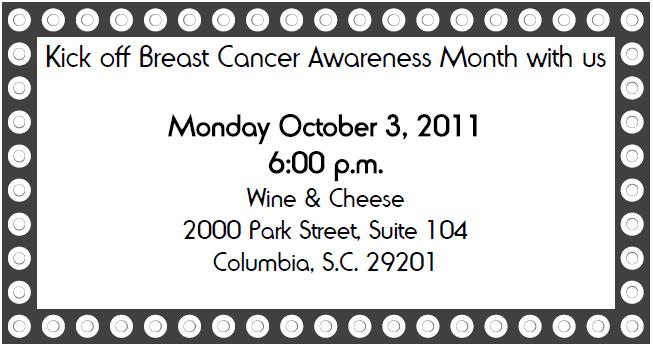
breast cancer awarenessIn or near the Columbia, SC area? If so, join The Center for Natural Breast Reconstruction team and other physicians and clinicians from all over South Carolina and the Green Hair Salon as we host our very own breast cancer awareness party.

During this fun-filled evening, you’ll have the opportunity to socialize with various physicians from across the state and ask questions about breast cancer, prevention, and breast reconstruction. Throughout the night, our team members, as well as other physicians, will speak about breast cancer and what you need to know to make smart, informed decisions about breast cancer.

Whether you know of someone who has faced breast cancer, or are currently fighting the battle with breast cancer, this event is for all women who are eager to educate themselves about their breast health options.

green hair salon

center for natural breast reconstruction

See below for more details on this event:

When: Monday, October 3, 2011, at 6 p.m.

Where: 2000 Park Street, Suite 104, Columbia, SC 29201

Food & Drink: Wine and cheese will be offered

Admission: FREE

RSVP appreciated, but not required: (866) 374-2627

We hope to see you there! And don’t forget, bring your questions.

Have a Question About Natural Breast Reconstruction?

Charleston breast surgeonThe questions below are answered by Charleston breast surgeons, Dr. Richard Kline and Dr. James Craigie of The Center for Natural Breast Reconstruction.

How long does a DIEP flap breast reconstruction last?

Reconstruction of one breast with a DIEP usually takes 4 – 6 hours, and reconstruction of both breasts usually takes 6 – 8 hours. The individual patient’s anatomy accounts for most of the variability. The surgery is usually followed by a 4-day stay in the hospital. Just in case you meant “last” as in will you have to have it redone like with implant reconstruction, the answer is: a successful DIEP breast reconstruction is designed to “last” a lifetime. You may desire aesthetic improvements over time as your reconstructed breasts will behave much like your natural breasts.

Will I have to have another surgery at a future date for maintenance?

Probably not for “maintenance,” but most patients require at least 2 surgeries total (sometimes more) to complete their reconstruction. The second stage of the reconstruction is typically performed 3 months or more after the first stage, taking 2 – 4 hours, and is usually an outpatient procedure. Common things done during the second stage include reshaping the breast mounds, improving the shape of the donor site (tummy or buttocks), and often making new nipples.

For an avid athlete, softball and running, what breast reconstruction do you recommend as the least limiting to continuing sports activities?

All methods have their potential downsides.

Reconstruction with an implant requires elevating the pectoralis major muscle to put the implant under it, as the skin alone is usually not strong enough to hold the implant. While this is usually well-tolerated, it could potentially affect the function of the muscle.

Flap reconstruction using the body’s own tissue usually involves taking extra fat from the abdomen (DIEP flap) or buttocks (GAP flap). No muscle is removed in either case, but it is still possible for muscle function to be affected. While there is room for debate in this area, my feeling is that some disruption of the buttock muscle is probably better tolerated than disruption of the abdominal muscle (rectus abdominus).

Want to learn more about your breast reconstruction options? Visit our Facebook page.

Do You Know Your Breast Reconstruction Options?

breast reconstruction optionsWe’re thrilled to share some exciting news with you, today! Dr. Richard Kline, Charleston breast surgeon, and the lovely Leslie Haywood, owner of Grill Charms™ and breast cancer survivor, were recently interviewed on one of our local Charleston news channels. During this interview, Leslie shares her inspirational story of breast cancer survival and how she chose to have the breast surgeons of The Center for Natural Breast Reconstruction perform her natural breast reconstruction.

Dr. Richard Kline of The Center for Natural Breast Reconstruction spoke about breast reconstruction options for women who are currently undergoing treatment for breast cancer or who have had a mastectomy.

See below for the interview:

If you want to learn even more about Leslie Haywood’s story (and get a chuckle from her hilarious narrative), click here to view one of our recent blog interviews with her.

For those of you who aren’t aware of The Center for Natural Breast Reconstruction and what we do, here’s a brief description:

Charleston plastic surgeons Dr. James Craigie and Dr. Richard Kline specialize in breast reconstruction for women who have undergone mastectomy and those who are considering risk reducing prophylactic surgery. Some of the procedures performed by these Charleston breast surgeons include DIEP, SIEA, and GAP free flap breast reconstruction, which utilize your own tissue with no implants and no muscle sacrifice.

Our Charleston breast surgeons also perform nipple sparing mastectomy, reconstruction after lumpectomy, microsurgical breast reconstruction, and breast restoration. Visit The Center for Natural Breast Reconstruction website at http://www.naturalbreastreconstruction.com/.