Archives for June 2011

5 Ways to Improve Your Mental Health

mental healthYour mental health is a vital part of your overall health, yet we often ignore it. When you feel mentally alive, your physical health improves as well. Follow these five tips to improve your mental health and increase your happiness.

1. Address negative beliefs.

Most of us hold negative beliefs, and they have a detrimental effect on our mental and physical health. We choose to hold these beliefs for whatever reason, and some may be valid while others are outdated or simply incorrect. Negative beliefs lead to a negative attitude, which saps your energy and alienates family members, caregivers, and friends.

To change a negative belief, you must identify it. Ask a trusted friend for help with this. Once you have determined which are your negative beliefs, ask yourself three things: where they came from, whether they are true, and whether you still want to hold onto them. Letting go of negative beliefs can be difficult but tremendously freeing, and it must be your decision to move forward without them. No one can force you to release a negative belief.

2. Replace the negative with a positive.

Whenever a negative thought creeps into your mind, focus on the positive of the situation instead. The negative thought will float off, and you’ll be happier, more relaxed, and able to deal with the situation as a whole. This is not to say you don’t need to deal with negative thoughts or situations—sometimes you do—but often negative thoughts are holdovers from those negative beliefs you’re trying to lose.

For example, if you’ve lost 10 pounds and have a negative thought about your ability to continue losing, remind yourself that you’ve already lost 10. Tell yourself how good you feel, and encourage yourself to keep going. If you let a negative thought stay in your mind, you’ll fall into it and have a difficult time climbing out of it. Concentrate on the positive, and don’t dig yourself a negative hole.

3. Reduce stress.

Stress causes not only physical problems, but also mental blocks and issues. Reducing stress is one of the fastest ways to boost your mental health. One quick way to feel better is to take three deep breaths: inhale through your nose, close your eyes and hold it for two seconds, and then exhale through your mouth. Exhale as fully as you can, and feel the stress melt.

Several other ways to decrease stress include exercise, meditation, massage, and aromatherapy. Sometimes walking away and being alone for 5–10 minutes or listening to your favorite music is all you need to reduce anxiety. Experiment to find your best stress relief.

4. Take a break from your life.

A change of scenery is always good for your mental health. Take a week-long vacation at least once a year. You’re doing yourself and your family a disservice if you accrue vacation time and never use it. Find the time to do something for you. Get away and explore new places, or take a week off to work on a hobby you never seem to have time to enjoy. You’ll return refreshed, relaxed, and happier.

5. Exercise your mind as you do your body.

We move through each day doing what we must, but we don’t stimulate our minds as often or as deeply as we should. Your mind craves challenge and creativity, and you feel alive and alert when you give your mind a new job. Take a class, learn a new hobby, go to a symphony or museum, or do the crossword in the newspaper. Try something new and excite your brain, as well as improve your memory.

Your mental health is just as important as your physical health, and the more you take care of your mind and exercise it, the happier you’ll be. If you do it consistently, the benefits last long into old age.

What’s your favorite way to take care of your mental health?

Does Radiation Affect My Options For Breast Reconstruction?

Dr. James Craigie

Dr. James Craigie

The question below is answered by Dr. James Craigie of The Center for Natural Breast Reconstruction.

I am not sure if I will need radiation after my mastectomy. What factors should I consider before going ahead with breast reconstruction?

Radiation therapy is part of the treatment for breast cancer for some but not all patients. To determine if it is necessary for any individual, the details of the cancer or the final path results must be known. The most common situation for radiation after mastectomy is based on the size of the cancer and the number of positive lymph nodes.

When a patient would benefit from radiation the treatment may affect the options for breast reconstruction as well as the timing of the reconstruction. There are several advantages to starting the breast reconstruction at the time of the mastectomy. These include: the breast surgeon can save more of the breast skin or even the nipple and this can set the stage for the best possible result, and avoiding an extra step and an extra recovery period.

If radiation will definitely be needed after mastectomy then I do not recommend immediate natural breast reconstruction because the radiation can possibly damage the new breast. In this situation the reconstruction would start approximately 6 months following radiation. These decisions are best made following the advice of your oncologist, breast surgeon, and plastic surgeon all working together. For this reason I am a strong advocate of the multi-specialty breast conference where each patient can be presented to all the specialists at once so they can share their opinions right away. Cooperation between experts can ensure better results and more options for each patient.

It is important to remember that if you need radiation for the treatment of breast cancer it does not mean you cannot have a very good result with natural breast reconstruction. It may however determine the order and timing of when the breast reconstruction should begin.

—James E. Craigie, MD


Important Self-Exams Every Woman Should Perform

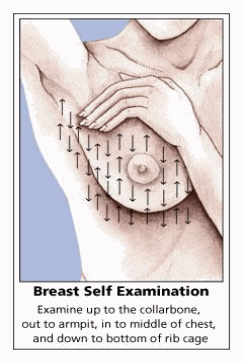
Image to the left taken from Cancer.org.


Self-exams help you to detect changes in your body between visits to your doctor. Many lives have been saved due to diligent self-examination, and following are two self-exams you’ll want to perform regularly.

BSE or breast self-exam

Each woman has her own method of examining her breasts. Some do a systematic BSE monthly or bimonthly, while others keep an eye on their breasts by regularly feeling them in the shower or while lying in bed. Often, women ask their significant others to help them check, or they visit the doctor several times a year for a clinical exam.

While a regular BSE with a consistent technique is best, perfect technique is not as important as frequency and diligence. Sometimes, women stress needlessly about doing it correctly. As long as you feel the entire breast and overlap your motions, you’re doing it right. The goal of a BSE is to know what is normal for you and check for changes.

If you’re not sure whether you’re feeling the entire breast, cancer.org suggests the following BSE routine:

  • Lie down and bend your arm behind your head to spread the breast tissue evenly over your chest, making it easier to examine.
  • Imagine your breast is divided in vertical lines from your underarm to breastbone, and use the finger pads of your other hand to feel for lumps in an up-and-down pattern along those lines. Move in dime-sized circles, slightly overlapping the previous line as you move up and down.
  • Use different levels of pressure at each spot so you feel all the breast tissue, especially if you have large breasts. You can feel the tissue close to the skin with light pressure, tissue in the upper half of the breast with medium pressure, and lower breast tissue with deeper pressure. There will be a ridge at the bottom of each breast, which is normal. If you have questions about pressure, talk with your doctor or nurse.
  • Examine the entire breast area, and then repeat the exam on your other breast.
  • Stand in front of a mirror, press your hands on your hips, and look at your breasts for changes in shape or size. Also look for rashes, redness, or dimpling.
  • Raise each arm slightly, and feel the underarm for lumps.

Some women may find it easier to examine their breasts in the shower, which is fine, as long as you are thorough—or add this routine to your shower exam. Current medical literature suggests that the above procedure is the most effective for finding lumps as soon as possible.

Skin exam

A regular skin exam will help you keep an eye on moles, freckles, and other spots that could become cancerous. It should be done at least once a month, and if you ask your doctor to do a full-body exam first, you’ll have a baseline. While it may sound daunting, after you’ve done a full skin exam a couple of times, it shouldn’t take more than 10–15 minutes.

Warning signs of skin cancer include a change in an existing mole or spot, or any growth or spot that . . .

  • Appears during adulthood.
  • Increases in size or thickness.
  • Changes in texture or in color—especially if it turns pearly, multicolored, brown, or black.
  • Has an irregular shape or outline.
  • Is bigger than a pencil eraser.
  • Continues to hurt, itch, scab, or bleed longer than three weeks.

If you see any of these signs, don’t wait or hope it goes away. See a doctor, preferably a dermatologist.

Loved this post and want to receive even more helpful tips? Sign up for our newsletter using the subscription box on the right sidebar.