Important Self-Exams Every Woman Should Perform

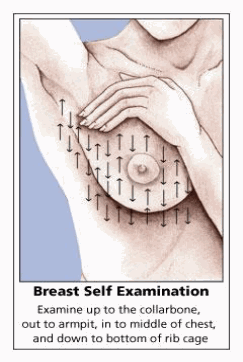
Image to the left taken from Cancer.org.


Self-exams help you to detect changes in your body between visits to your doctor. Many lives have been saved due to diligent self-examination, and following are two self-exams you’ll want to perform regularly.

BSE or breast self-exam

Each woman has her own method of examining her breasts. Some do a systematic BSE monthly or bimonthly, while others keep an eye on their breasts by regularly feeling them in the shower or while lying in bed. Often, women ask their significant others to help them check, or they visit the doctor several times a year for a clinical exam.

While a regular BSE with a consistent technique is best, perfect technique is not as important as frequency and diligence. Sometimes, women stress needlessly about doing it correctly. As long as you feel the entire breast and overlap your motions, you’re doing it right. The goal of a BSE is to know what is normal for you and check for changes.

If you’re not sure whether you’re feeling the entire breast, cancer.org suggests the following BSE routine:

  • Lie down and bend your arm behind your head to spread the breast tissue evenly over your chest, making it easier to examine.
  • Imagine your breast is divided in vertical lines from your underarm to breastbone, and use the finger pads of your other hand to feel for lumps in an up-and-down pattern along those lines. Move in dime-sized circles, slightly overlapping the previous line as you move up and down.
  • Use different levels of pressure at each spot so you feel all the breast tissue, especially if you have large breasts. You can feel the tissue close to the skin with light pressure, tissue in the upper half of the breast with medium pressure, and lower breast tissue with deeper pressure. There will be a ridge at the bottom of each breast, which is normal. If you have questions about pressure, talk with your doctor or nurse.
  • Examine the entire breast area, and then repeat the exam on your other breast.
  • Stand in front of a mirror, press your hands on your hips, and look at your breasts for changes in shape or size. Also look for rashes, redness, or dimpling.
  • Raise each arm slightly, and feel the underarm for lumps.

Some women may find it easier to examine their breasts in the shower, which is fine, as long as you are thorough—or add this routine to your shower exam. Current medical literature suggests that the above procedure is the most effective for finding lumps as soon as possible.

Skin exam

A regular skin exam will help you keep an eye on moles, freckles, and other spots that could become cancerous. It should be done at least once a month, and if you ask your doctor to do a full-body exam first, you’ll have a baseline. While it may sound daunting, after you’ve done a full skin exam a couple of times, it shouldn’t take more than 10–15 minutes.

Warning signs of skin cancer include a change in an existing mole or spot, or any growth or spot that . . .

  • Appears during adulthood.
  • Increases in size or thickness.
  • Changes in texture or in color—especially if it turns pearly, multicolored, brown, or black.
  • Has an irregular shape or outline.
  • Is bigger than a pencil eraser.
  • Continues to hurt, itch, scab, or bleed longer than three weeks.

If you see any of these signs, don’t wait or hope it goes away. See a doctor, preferably a dermatologist.

Loved this post and want to receive even more helpful tips? Sign up for our newsletter using the subscription box on the right sidebar.


Are Implant Problems Affecting Your Life?

implant problemsBelow is an In Her Words post from one of our patients who came to us with implant problems. Read her story below:

I am so thankful to Dr. Craigie and Dr. Kline and Christina for making me feel at ease. Meeting someone for the first time and having surgery the same week was a lot to take in, but thanks to everyone, including The Center for Natural Breast Reconstruction staff, Christine, and Gillian. And a special, big thank you to Gail for helping me with my insurance and all the conversations we had prior to my office visit with Dr. Craigie. Gail, thank you for making me feel like a person not a number, you are wonderful!

I cannot say enough about the results from my surgery! It was absolutely fantastic to say the least! I am amazed how natural I look! I really am excited to have my follow-up. Can it get any better? I do not have the pain in my breasts or the hardness and pulling from the implant anymore. I can lift my arms straight up over my head now! I noticed that I don’t have the flu-like feeling anymore—it’s gone!

Before coming to Dr. Craigie’s office, I have had five painful surgeries with implants and expanders going wrong with infections, plus lengthy hospital stays and home care. This was over a period of four years—four years taken out of not only my life but also my family’s life. Just think of how much time and money was wasted on paying insurance companies when I could have had only one surgery and a follow-up! If I only knew there was an alternative option before having my first implants.

My goal is to get the word out. Women need to know that you do have an alternative, besides using implants. Utilizing the body’s own tissue! Again, I was never given this option.

I cannot thank you enough Dr. Craigie and Dr. Kline for your skilled surgical talents and dedication in this field that made me look and feel like a women again!

Sincerely,
D.N South Amherst, Ohio

Do you know of someone whose life is affected by implant problems? Share this story with them.

The Importance of Sleep and How to Get More of It

sleep apneaWe know we need it, but we don’t get enough. Sleep can be elusive, and most of us have problems sleeping occasionally. According to the National Sleep Foundation (NSF), at least 40 million Americans suffer from sleep disorders, and 60 percent of adults report having insomnia at least a few times a week.

While the occasional sleepless night is nothing to worry about, the Harvard Women’s Health Watch reported that chronic insomnia decreases the immune system and leads to health problems such as weight gain and hypertension. These health issues, as well as medication and painful disorders such as arthritis, often result in continued insomnia, creating a vicious cycle.

Other health issues linked to sleep loss include:

  • Impaired memory and learning problems.
  • Less effective decision-making.
  • Daytime drowsiness, thought to affect some 40% of adults per the NSF.
  • Irritability, anxiety, and impatience.
  • Mood swings.
  • Higher stress levels.
  • Diabetes.

The need for sleep varies, with an average of eight hours being the ideal for most adults. Shift workers, truck drivers, medical professionals, and teens and young adults tend to live on less sleep than they truly need, causing problems for themselves and others.

While quantity of sleep is important, quality of sleep is vital to your health. You’re better off sleeping soundly for 7 hours than sleeping restlessly for 9 hours. You can take some simple steps to improve both the quality and quantity of your sleep:

  • Avoid strenuous exercise, alcohol, and caffeine at least four hours before bed.
  • Keep a regular sleeping and waking schedule, even on weekends.
  • Reconsider keeping a television or computer in your bedroom. The light from the screen can disrupt sleep.
  • Make sure your mattress is comfortable, turn it regularly, and replace it after 5–7 years.
  • Keep your room as dark as possible and slightly cool.
  • If your sleep partner tends to toss and turn, consider a larger bed or one of the newer beds that has dual controls for firmness. These modern beds tend to minimize disruption of your sleep if your partner is restless.

While short-term insomnia is usually not an issue, continued sleeplessness may indicate a problem such as sleep apnea or narcolepsy. Most sleep disorders go undiagnosed, and could be discovered and treated with a simple test at your local hospital or sleep center. If you have insomnia more than once a week, talk to your doctor about a referral for sleep testing.

For more tips on health and wellness, subscribe to our blog.

Can I Have My Current Implant Removed to Receive a Muscle-Sparing Free Flap Breast Reconstruction?

dr. richard kline

Dr. Richard M. Kline, Jr.

The below question is answered by Richard M. Kline Jr., M.D., of The Center for Natural Breast Reconstruction.

I had reconstruction with implants after my breast cancer diagnosis in 2009. How hard is it to go back and do breast reconstruction with a flap? What would the recovery time be?  Also, does insurance give you a hard time about taking out the implants and revising having a flap?

It’s no trouble at all to remove implants and replace them with a muscle sparing free flap breast reconstruction. We’ve done it successfully hundreds of times. Unfortunately, roughly 30% of women who come to us are seeking conversion from a failed or unsatisfactory implant based reconstruction. Recovery time after flaps is usually 6 – 8 weeks, although some ladies recover much faster. I don’t think insurance usually gives you a hard time—once you’ve started the reconstruction process, they seem to follow through until you are finally content with your reconstructed breast.

—Richard M. Kline Jr., M.D

How to Maximize Insurance Coverage and Discover the Full Range of Benefits

health insuranceHealth insurance coverage can be confusing, and often patients don’t know what is covered, which can lead to problems and extra expense. Following are three ways to maximize your insurance coverage and get the most for your money.

Premium cost isn’t the only consideration.

Many employers offer only one health insurance policy, but you do have the option to purchase coverage elsewhere. If you choose to purchase privately, look at more than the monthly premium before buying. Plans vary widely in their coverage and total cost, and some will be a better fit with your family’s health situation and desired coverage.

You should consider several things when buying health insurance:

  • Coverage should be adequate for any current health issues, including paying for prescriptions, medical equipment, and services such as physical therapy and nursing care.
  • Pre-existing condition coverage varies, but normally there is a waiting period before insurance will cover those health issues.
  • Deductible is the amount you pay each year before insurance goes into effect. This may be separate from your copayment.
  • Coinsurance is the percentage you pay after insurance kicks in. This typically varies from 10–50%.
  • Maximum out-of-pocket expense is the maximum dollar amount you will pay each year. Once you have reached that amount, insurance pays 100% up to the maximum plan dollar limit.
  • Maximum plan dollar limit is the most the policy will pay. Plans may have an annual and / or lifetime maximum dollar limit.
  • Copayment is the amount you pay at the time you visit the doctor, pick up a prescription, or enter the hospital. This payment may or may not count toward your deductible.

You will also want to check whether your doctors and pharmacies are listed in the insurance company’s network of providers. If they are, your visits and prescriptions will cost less. If they aren’t, you’ll pay considerably more—and some plans will not cover any care given out of network.

Read your policy thoroughly.

It’s not exciting reading, but familiarizing yourself with your policy will avoid nasty surprises and extra cost and hassle later. Speaking of surprises, you might find services and products are covered that you never thought of, such as alternative treatments and over-the-counter medicine.

Insurers send updated policies regularly, so be sure to read those as well, and keep the summary of benefits handy for quick reference.

Double-check your policy before, during, and after you receive care.

Make sure that everything you need is covered by your policy. Check whether you will need referrals from your physician or authorizations from the insurance company before you go in for care. Every insurance company has specific procedures they follow, and straying from them can cost money or time.

Any time you receive care, you need to be proactive about ensuring that your doctor’s office is coding and submitting your information correctly. Afterward, carefully check all bills to see that the insurance company is paying them. Don’t be afraid to talk to the insurance company directly and do what you can to maximize your coverage.

Sign up for our RSS feed to receive instant updates.

How to Make Sure You and Your Doctor Communicate Effectively

breast reconstructionYour relationship with your doctor is a partnership, and one of the best ways you can help each other is to communicate effectively. You’ll avoid misunderstandings and hurt feelings, and the two of you can quickly move forward in your treatment. When it’s time for your next appointment, using the following tips can make a positive difference in your relationship.

Always be as honest and as specific as possible.

Even if you’re uncomfortable, tell the truth—your doctor can’t successfully treat you otherwise. If you’re not sure how to answer a question, say so instead of guessing. Your answers should be as specific as possible, even if you need to add more information or ask questions before replying.

Don’t be afraid to ask or tell your doctor anything—he or she has literally heard it all.

Listen, and then ask questions.

Sometimes while the doctor is talking, patients have an emotional reaction that prevents them from hearing the rest of what the doctor has to say. Listen to everything the doctor says, try not to react right away and let it process for a moment, and then ask questions.

Note anything unusual, and write down your questions before you go.

Keep a calendar or day planner with you, and jot down any symptom that is unusual for you. The night before you go to the doctor, make a note of these symptoms as well as questions you have. Often we go to the doctor with a list of questions in our head, and then forget what we wanted to ask. This step will save time for both of you during the appointment.

Never ignore unusual pain, discharge, or bleeding. Contact your doctor immediately.

Tell your doctor about everything you take.

Make a list of your medications and any dietary supplements you take, including vitamins and aspirin. Be sure to note dosage size and frequency. Give the list to your doctor for your file, and send a copy to your pharmacist. Update these lists at least once or twice a year.

Don’t be offended by non-medical questions.

Your doctor might ask about your job or what you do on weekends, and this is not to pry, but to evaluate how your lifestyle might be affecting your health. Stress, eating habits, and alcohol consumption may be factors in your condition.

Let your doctor know if he or she doesn’t communicate well with you.

Your doctor needs to know if his or her communication style isn’t effective. Think back on your last few appointments. Did he or she say anything that upset you, and was everything explained in a way you could understand? Were you comfortable talking with him or her?

Give your doctor specific suggestions to improve your partnership. If you’re not comfortable doing that in person, send an email or leave a voice mail after hours on the doctor’s private line.

Your doctor is there to help you—and he or she can do a much better job when you have built a relationship based on trust and good communication. This process can take a little time but is well worth the effort.

What do you and your doctor do to create effective communication?

An Unforgettable Ladies’ Night: East Cooper Medical Center’s Garden Party

garden partyDon’t miss the East Cooper Medical Center’s exciting Garden Party Event happening Thursday, May 12 from 5:30 – 8:00 p.m. This wonderful event will take place in the front lobby and outdoor garden area of the East Cooper Medical Center, and will feature free wine tastings, cheese, appetizers, and chocolates, as well as great giveaways! In addition to yummy snacks and beverages, guests will also enjoy live music in the garden, a unique “Peace, Love, & Hip Hop” exercise performance, maternity floor tours, and will have the chance to enter to win great giveaways.

Event attendees will also have the opportunity to listen to 12 informational talks given by local doctors and health professionals and ask questions pertaining to healthcare. In fact, one of the information talks will be given by The Center for Natural Breast Reconstruction’s Dr. James Craigie and Dr. Richard Kline on Flappers Do the Charleston: The Free Flap Breast Reconstruction Method.

Some of the other talk topics of the night include:

  • How to Talk to Your Teenagers
  • Breast Screening and Diagnosis: It Could Save Your Life
  • Shining Light Where the Sun Don’t Shine: From Hemorrhoids to Colon Cancer
  • Face Lifts: Rejuvenate Your Look
  • And more!

The address of the event is East Cooper Medical Center Lobby & Garden, 2000 Hospital Drive, Mount Pleasant, SC.

Women are encouraged to register for this event so that the East Cooper Medical Center can purchase enough food and wine for all attendees to enjoy! To register for this free event, please call 843-884-7031.

All women are invited to this event, so share this post with your mothers, sisters, aunts, best friends, and grandmothers. We hope to see you there!

How to Talk to your Spouse about Health Concerns without Scaring Him

health concernsYou need to talk to your husband about your health, but it scares him when you bring it up. You need to have a strategy for talking to him. You can’t stop him from fearing for you—he loves you and wants you healthy and safe—but you can minimize his anxiety with a few simple tips.

Be clear on what you need to tell him at this point.

One of the worst things you can do is to throw a worst-case scenario at him from the start. That would unnecessarily scare anyone. If you’ve found a lump, tell him you’re going to have it checked out. Answer his questions, but don’t put thoughts in his mind that don’t need to be there at this time.

Have the facts in front of you, and keep it short and to the point.

Men often respond better when they can see the facts. Show him studies, doctors’ websites and blogs, WebMD—anything that clearly states the facts so he can see for himself. Practice what you’re going to say, and focus on being clear and succinct.

When you talk to him, get right to the point and then stop. If you ramble, his attention may wander, or he may tune you out right when you need him to listen. Ask him if he has any questions, and answer them honestly—but again, keep it short.

Try to keep your emotions in check during the discussion.

When women are upset or crying, their husbands feel powerless and unable to solve the problem, so they become frightened and angry. If you can hold your emotions just until you’ve finished telling him what you need to, he’ll hear you more clearly.

We’re not saying you need to stifle your emotions, but give him a chance to hear and comprehend what you’re saying without becoming frightened because you’re upset.

Have the doctor explain it to him.

If you’re not comfortable talking to him, or you think he might have questions you can’t answer, have the doctor call him at home. If you take him to the doctor with you, his mind will run wild while you’re in the waiting room, and he’ll scare himself. Leave the room while he’s on the phone, and do not have the doctor call him at work unless it’s good news.

Give him time to process.

After you’ve talked to him, go to another room for a while to let him sort through his thoughts. He needs time to process what you’ve told him, and he needs to be alone. Tell him to take his time. It might be five minutes or five hours, but give him the time he needs.

What strategies have you used when talking to your husband about your health?

Will My Insurance Company Pay for a Mastectomy to Reduce My Risk of Breast Cancer?

health insuranceWe’re putting a little twist on our Ask the Doctor post today. We receive lots of great questions from patients; some are medical while others pertain to insurance, billing, and other-office related information. Today, I will be answering a popular question we receive regarding insurance.

I’d like to have a mastectomy to reduce my risk of breast cancer.  Will my insurance company pay for it?

Most insurance companies do have criteria under which they will consider a prophylactic mastectomy medically necessary—as a reminder, if they pay for your mastectomy they must also cover a reconstructive procedure of your choice. There are always exceptions to this rule, as outlined in WHCRA 1998, but this law does protect the majority of women insured in the United States.

I’ll highlight some of the actual criteria obtained from medical policy documents from some of the nation’s largest insurers. This is a pretty comprehensive list but it’s always a good idea to consult your plan’s medical policy documents to determine their specific coverage criteria prior to undergoing any medical / surgical procedure.

“BIG INSURANCE CO #1” covers prophylactic mastectomy as medically necessary for the treatment of individuals at high risk of developing breast cancer when any ONE of the following criteria is met:

Individuals with a personal history of cancer as noted below:

Individuals with a personal history of breast cancer when any ONE of the following criteria is met:

  • Diagnosed at age 45 or younger, regardless of family history.
  • Diagnosed at age 50 or younger and EITHER of the following:
    • At least one close blood relative with breast cancer at age 50 or younger.
    • At least one close blood relative with epithelial ovarian, fallopian tube, or primary peritoneal cancer.
  • Diagnosed with two breast primaries (includes bilateral disease or cases where there are two or more clearly separate ipsilateral primary tumors) when the first breast cancer diagnosis occurred prior to age 50.
  • Diagnosed at any age and there are at least two close blood relatives* with breast cancer or epithelial ovarian, fallopian tube, or primary peritoneal cancer diagnosed at any age.
  • Personal history of epithelial ovarian, fallopian tube, or primary peritoneal cancer.
  • Close male blood relative with breast cancer.
  • An individual of ethnicity associated with higher mutation frequency (e.g., founder populations of Ashkenazi Jewish, Icelandic, Swedish, Hungarian, or Dutch).
  • Development of invasive lobular or ductal carcinoma in the contralateral breast after electing surveillance for lobular carcinoma in situ of the ipsilateral breast.
  • Lobular carcinoma in situ confirmed on biopsy.
  • Lobular carcinoma in situ in the contralateral breast.
  • Diffuse indeterminate microcalcifications or dense tissue in the contralateral breast that is difficult to evaluate mammographically and clinically.
  • A large and / or ptotic, dense, disproportionately-sized contralateral breast that is difficult to reasonably match the ipsilateral cancerous breast treated with mastectomy and reconstruction.
  • Personal history of epithelial ovarian, fallopian tube, or primary peritoneal cancer.
  • Personal history of male breast cancer.

Individuals with no personal history of breast or epithelial ovarian cancer when any ONE of the following is met:

  • Known breast risk cancer antigen (BRCA1 or BRCA2), p53, or PTEN mutation confirmed by genetic testing.
  • Close blood relative with a known BRCA1, BRCA2, p53, or PTEN mutation.
  • First- or second-degree blood relative meeting any of the above criteria for individuals with a personal history of cancer.
  • Third-degree blood relative with two or more close blood relatives with breast and / or ovarian cancer (with at least one close blood relative with breast cancer prior to age 50).
  • History of treatment with thoracic radiation.
  • Atypical ductal or lobular hyperplasia, especially if combined with a family history of breast cancer.
  • Dense, fibronodular breasts that are mammographically or clinically difficult to evaluate, several prior breast biopsies for clinical and / or mammographic abnormalities, and strong concern about breast cancer risk.

Who is a close blood  relative? A close blood relative / close family member includes first- , second-, and third-degree relatives.

A first-degree relative is defined as a blood relative with whom an individual shares approximately 50% of his / her genes, including the individual’s parents, full siblings, and children.

A second-degree relative is defined as a blood relative with whom an individual shares approximately 25% of his / her genes, including the individual’s grandparents, grandchildren, aunts, uncles, nephews, nieces, and half-siblings.

A third-degree relative is defined as a blood relative with whom an individual shares approximately 12.5% of his / her genes, including the individual’s great-grandparents and first-cousins.

GET IT IN WRITING: Some of the above criteria may sound like Greek to most of us.  Ultimately the key to finding out if your insurance will consider prophylactic mastectomy in your individual case lies in the hands of your physician and you. A comprehensive set of medical records clearly outlining your particular risk along with a request made to your insurance company for written pre-authorization or pre-determination of benefits is the best thing to do to assure if your insurance company will consider your procedure medically necessary.

–Gail Lanter, CPC, Office Manager

Exercising as Fun Rather Than Drudgery

We all know exercise is a vital part of creating a healthy life, but often, we see exercise as another chore we need to finish. Following are some ideas to help you play and have fun with exercising instead of putting it off or dreading it. No matter which exercise you choose, set realistic goals for yourself and focus on fun.

exercisePlay. Do what you enjoy.

If you pick an activity you like, you’ll look forward to doing it regularly, and you’ll be more likely to stick with it long term. It doesn’t matter what it is as long as you’re moving, so be creative. Is there a sport you’ve always wanted to try, or perhaps a form of dancing you enjoy? Did you love to roller skate as a kid? There’s no reason you can’t learn a new sport, dance, or roller skate now.

If you prefer being indoors, you might like weight lifting, yoga, swimming, or Zumba dance. If you’re an outdoors person, try rock climbing, skiing, bicycling, or simply walking. The more you love what you’re doing, the more often you’ll do it, and the more benefits you’ll reap from it.

Make a fun date with yourself.

Decide which time of day you would most enjoy moving, and schedule it in writing. Be realistic—if you’re not a morning person, don’t plan a 6 a.m. workout. Would you enjoy going to a yoga class after work, or taking the dog for a walk after dinner? Decide which days and times suit you best, and start there.

Think of this time as “I get to . . .” instead of “I have to . . .” because your attitude before you exercise will dictate your frame of mind while you’re doing it.

Take it easy at first, and then challenge yourself to do just a little more.

Don’t expect miracles the first day or the first week. Again, be realistic with yourself. Start slowly, and do what you can. If five minutes is your limit today, great—you might be able to go just a little longer tomorrow and do 5 ½ or 6 minutes. By starting slowly, you’ll have a sense of accomplishment without hurting yourself by doing too much, too soon.

Find an exercise buddy.

If you have a friend who makes you laugh or is fun to be with, maybe he or she would like to exercise with you. If you’re going for a walk, take the dog, or walk with your spouse or children. Exercise time can double as family time, and it’s easier to stay motivated when you have other people to exercise with.

Variety is the spice of life.

Nowhere does that saying apply more than to exercise. Varying your workout with new activities will not only keep you motivated, but changing your routine also works different parts of your body. Try something new once a month, and have different activities for the seasons.

What do you do to keep exercise fresh and fun?